QUICK TOUR SEARCH >>>>  
 
Tours By Region
» Home  » Tour Calendar » Specials  » Resources  » Forms » About Us » Contact Us
» East Asia
» Indochina
» South Asia
» Central Asia
» Middle East
» Europe
»
Africa Tours

Algeria

Benin
Botswana

Burkina
Faso

Egypt
Eritrea 
Ethiopia
Ghana
Kenya
Libya
Madagascar
Mali
Mauritius
Morocco
Namibia
Rwanda
Senegal
South Africa
South Sudan
Sudan
Tanzania
Togo
Tunisia
Uganda
Zambia
Zimbabwe
» Americas
» Australia
» Polar Regions
» Islands

Tanzania
Country information


General Country and Park Info
Mount Kilimanjaro National Park
Serengeti National Park
Tarangire National Park
Lake Manyara National Park
Bestway Safaris in Tanzania

General Country & Park Information
1) General Weather Information

TANZANIA'S WEATHER PATTERNS
JAN
FEB
MAR
APR
MAY
JUN
JUL
AUG
SEP
OCT
NOV
DEC
_
                       
dry
variable
light rain
rainy


2) The Role of national Parks In Tanzania


Conservation is the primary role of Tanzania's national arks which provide the core of entire ecosystems for the preservation of habitats heritage and wildlife. Secure breeding grounds are ensured, where animals can thrive in their natural safe from the conflicting interests of a growing human population.

The park system protects internationally recognised bastions of biodiversity and World Heritage Sites, redressing the balance for those areas of the country affected by deforestation, agriculture and urbanisation. Now Tanzania National Parks (TANAPA) is acquiring even more land to expand some parks and raise the status of other areas to secure traditional wildlife corridors - tracts of land which are important for seasonal migrations between protected areas.

By choosing to visit Tanzania you are supporting a developing country's extraordinary investment in the future. In spite of population pressures Tanzania has dedicated almost 43,000 square kilometers to national parks. Including other reserves, conservation areas and marine parks, Tanzania protects 38% of its territory- much more than many of the world's wealthier nations.

back to top

3) Tourism

Tourism provides valuable revenue to support the conservation work of the national parks, wildlife research and education, and the well being of local communities. In addition, tourism helps to generate international awareness of conservation issues. Simply the physical presence of more people in a park can help to deter illegal activity, assisting the park rangers with their game management work.

But TANAPA has resisted the temptation to cash in on the short term gains of mass tourism. Understanding our responsibilities not only to Tanzania, but to the world in the conservation and management of global resource, we are committed to low impact sustainable visitation to protect the environment from irreversible damage while creating a first class ecotourism destination.

Human activity is closely monitored and all development strictly regulated. Buildings in the parks must be unobtrusive and waste disposal carefully controlled. Park visitors and facilities are widely distributed to prevent harassment of animals and to minimise the human imprint on the environment. Even in a Tanzania's most popular park, the Serengeti, more than 7,000 square kilometers- almost half the park-remain a wilderness zone with no roads.

4) The Local People

Guardianship of this rich resource, however, relies on the goodwill of the parks' neighbours. TANAPA is working hard to ensure that local communities have a sense of ownership and a vested interest in the future of the parks by sharing the rewards of conservation and delivering tangible benefits. A percentage of park revenues assists community development initiatives, such as schools, health dispensaries, water schemes and roads. Villagers are encouraged to develop cultural tourism projects to cultivate their own financial returns from park visitors. Many locals are employed within the parks by lodges and tour operators - and by TANAPA, particularly in the fight against poachers who desire to steal from the parks for profit or subsistence.

Poaching not only involves commercial hunting of elephant ivory or rhinoceros for rhino horn, but also cutting trees for building poles and firewood, collecting honey, illegal fishing, hunting animals and fowl for meat, as well as taking plants where they've been wiped out beyond the parks for use in traditional medicines. When villagers depend on the park for employment, and witness the community benefits from the presence of a park, they are more likely to defend the protected area and report poaching. TANAPA works with communities to teach sustainable environmental management, assist with tree planting, establish nurseries and to promote cultural, as well as wildlife, conservation.


back to top

5) Looking ahead

The future depends on those who will inherit the parks. TANAPA is taking the lead in educating local people, providing study materials and teacher training for schools and showing conservation videos in Swahili in villages. Schools and community groups are offered free visits to the parks to demonstrate the importance of preserving these habitats.

The support of research projects is an important part of TANAPA's commitment to the future. Tanzania's chimpanzees are the subject of the longest study of its kind in the world. Scientists working in Tanzania's parks continue to find hitherto undiscovered species of butterflies, birds, beetles and plants. Surveys monitor the distribution and number of animals, test water quality, identify disease outbreaks and check invasion by exotic species.

The national parks are a lifeline for animals which would otherwise face extinction by human hands. They offer refuge to many endangered and vulnerable species, safeguarding shrinking habitats, providing protected breeding and sanctuary to allow threatened species to recover. With everyone's support, these vital ecosystems will be preserved for the benefit of future generations.


back to top


Tanzania's National Parks
Mount Kilimanjaro National Park

Kilimanjaro. The name itself is a mystery wreathed in clouds. It might mean Mountain of Light, Mountain of Greatness or Mountain of Caravans. Or it might not. The local people, the Wachagga, don't even have a name for the whole massif, only Kipoo (and now known as Kibo), for the familiar snowy peak that stands imperious, overseer of the continent, the summit of Africa.

Kilimanjaro, by any name, is a metaphor for the compelling beauty of East Africa. When you see it, you understand why. Rising in absolute isolation, at 5,895 metres (19,336 feet), Kilimanjaro is Africa's highest mountain and one of the world's most accessible high summits, a beacon for visitors from around the world. Most climbers reach the crater rim with little more than a walking stick, proper clothing and determination.

Those who reach Uhuru Point, the actual summit, or Gillman's Point on the lip of the crater, will have earned their climbing certificates. And their memories.

But there is so much more to Kili than her summit. A journey up her slopes takes you on a climatic world tour, from the tropics to the arctic. The grassy and cultivated lower slopes turn into lush rainforest, inhabited by elusive elephant, leopard, buffalo and antelope. Higher still, heath and moorland, covered with giant heathers, becomes surreal alpine desert and, finally, ice, snow and the magnificent beauty of the top of the continent.

Mount Kilimanjaro National Park
Size 755 sq km (about 470 sq miles).
Location Northern Tanzania.
Getting there 128 km (about 80 miles) from Arusha. About I Hour from Kilimanjaro airport.
What to do Six usual trekking routes to the summit and other more-demanding mountaineering routes. Day or overnight hikes on the Shira plateau. Nature trails on the lower reaches.
When to go Clearest and warmest conditions from December to February, but also dry (and colder} from July-September.
Accommodation Huts and campsites on the mountain. Several hotels and campsites outside the park.
NOTE: Climb slowly to increase your acclimatisation time and maximise your chances of reaching the summit.
To avoid altitude sickness, allow a minimum of 4 nights, preferably 5 or even more for the climb. Take your time and enjoy the beauty of the mountain.

back to top

Serengeti National Park

A million wildebeest ... each driven by the same ancient rhythm, fulfilling their instinctive role in the inescapable cycle of life: a frenzied 3 week bout of "territorial conquests and mating; survival of the fittest as 40 kilometre long columns plunge through crocodile infested waters on the annual exodus north; replenishing the species in a brief population explosion that produces more than 8000 calves a day before the 1000 kilometre pilgrimage begins again.

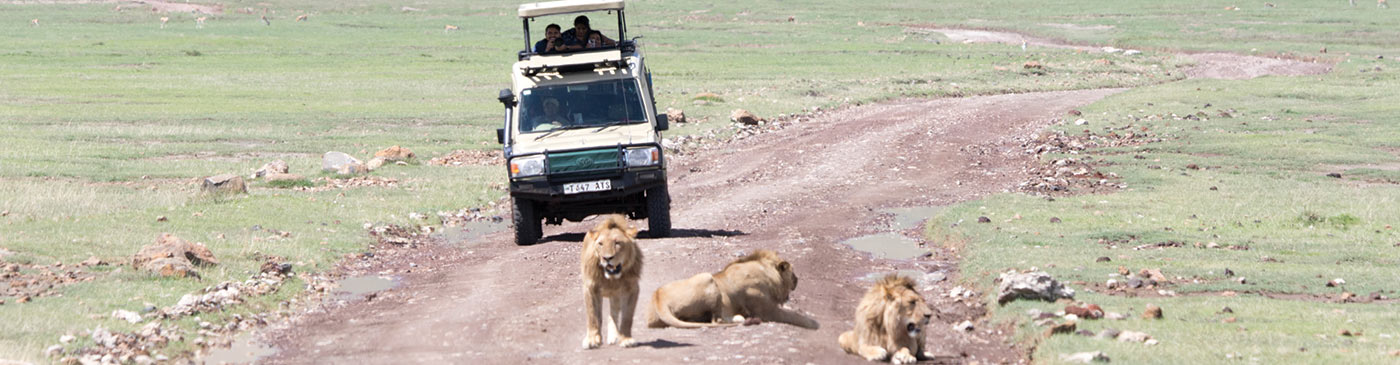
More than 6 million hooves pound the legendary plains of the Serengeti. Every year, triggered by the rains, more than a million wildebeest, 200,000 zebra and 300,000 Thomson's gazelle gather to undertake the long trek to new grazing lands. Tanzania's first and most famous park, the Serengeti, is renowned for its wealth of leopard and lion. The vast reaches of the park help the black rhino to fight extinction and provide a protected breeding ground for the vulnerable cheetah. Witness predator versus prey and the fundamental interdependence of the Serengeti's abundant species, from more than 500 varieties of bird to 100 types of dung beetle.

The Serengeti is a sense of seeing to the ends of the earth, the sunburnt savannah shimmering to the horizon. Yet, after the rains this golden horizon is magically transformed into an endless green carpet flecked with wildflowers. But there are also wooded hills, towering termite mounds and rocky kopjes, rivers lined with elegant stands of fig trees, ebony and acacia, stained orange by dust. It is so vast you may be the only human audience when a pride of lions masterminds a siege, focussed unswervingly on their next meal.

back to top

Serengeti National Park
Size 14,763 sq km (about 9,000 sq miles).
Location 335 km (about 208 miles) from Arusha, stretching north to Kenya and bordering Lake Victoria to the west.
Getting there Charter flights from Arusha, Lake Manyara and Mwanza. Drive from Arusha, Lake Manyara, Tarangire or Ngorongoro Crater.
What to do
Hot air balloon safaris, Maosai rock paintings and musical rocks. Visit neighbouring Ngorongoro Crater, Olduvai Gorge, Ol Doinyo Lengai volcana and Lake Natron's flamingos.
When to go To follow the wildebeest migration, December-July.
To see predators, June-October.
Accommodation 4 lodges, 4 luxury tented camps and camp sites scattered through the park; I luxury camp a lodge and 2 tented camps just outside.
NOTE: The route and timing of the wildebeest migration is unpredictable. Allow at least 3 days to be assured of seeing them on your visit - longer if you want to see the main predators as well.


Tarangire National Park

Day after day of cloudless skies. The fierce sun sucks the moisture from the landscape, baking the earth a

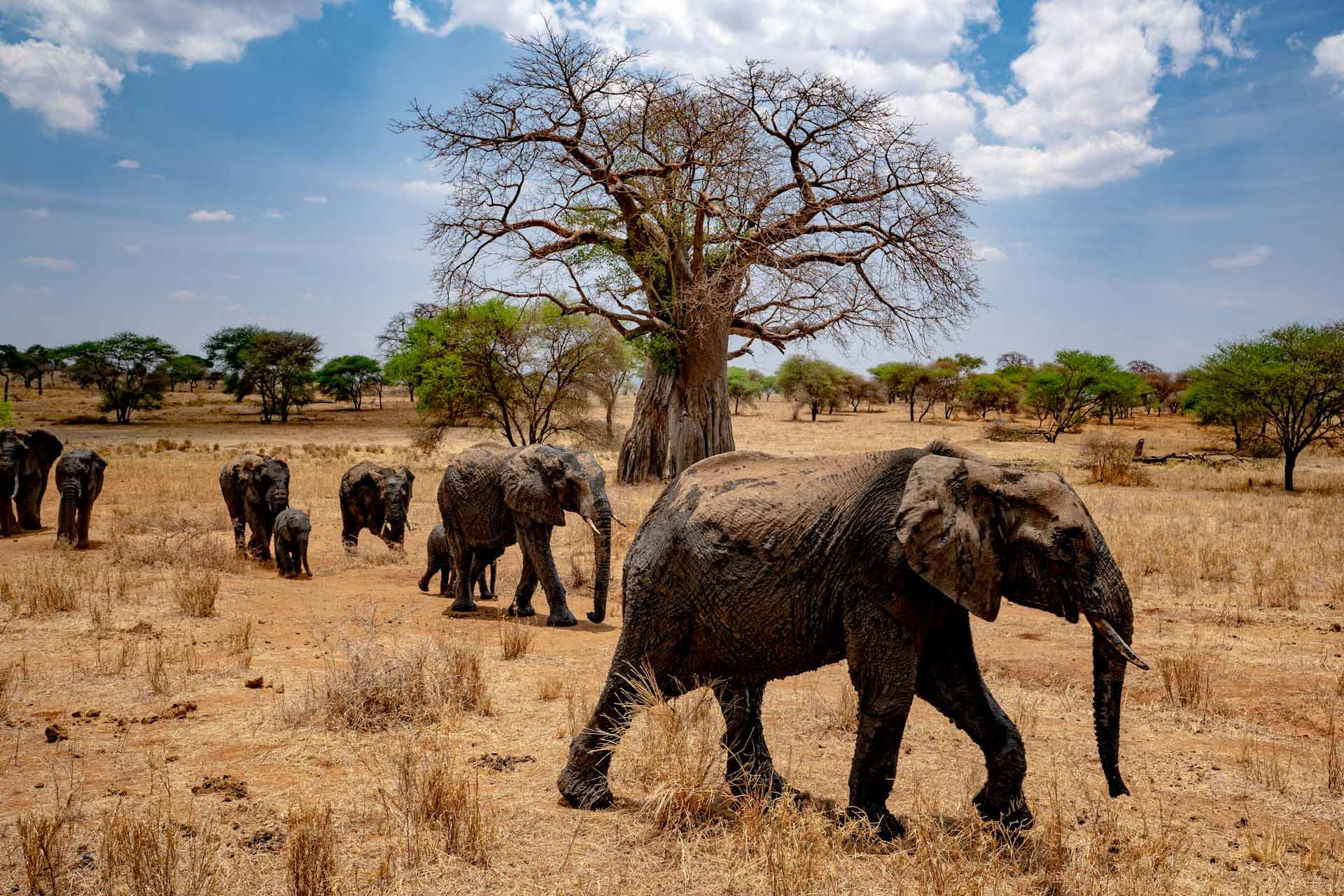
dusty red, the withered grass as brittle as straw. The Tarangire River has shrivelled to a shadow of its wet season self. But it is choked with wildlife. Thirsty nomads have wandered hundreds of parched kilometres knowing that here, there is always water. Herds of up to 300 elephants scratch the parched riverbed for underground streams while migratory wildebeest, zebra, buffalo, gazelle, hartebeest, eland and oryx crowd the shrinking lagoons. It's a smorgasbord for predators - the greatest concentration of wildlife outside the Serengeti ecosystem.

The rains scatter the seasonal visitors over a 20,000 square kitometre (about 12,500 sq miles) range until they exhaust the green plains and the river calls once more. But Tarangire's mobs of elephant are easily encountered, wet or dry. The swamps, tinged green year round, are the focus for 550 bird varieties, the most breeding species in one habitat anywhere in the world. On drier ground you find Kori bustards, the heaviest flying bird; the stocking thighed ostrich, the world's largest bird; and ground hornbills that bluster like turkeys. Tarangire's pythons climb trees, as do its lions and leopards, lounging in the branches where the fruit of the sausage tree disguises the twitch of a tail.

back to top

Tarangire National Park
Size 2600 sq km (about 1600 sq miles).
Location 118 kms (about 75 miles) southwest of Arusha.
Getting there Easy drive from Arusha or Lake Manyara; can continue on to Ngorongoro Croter and the Serengeti. Charter flights from Arusha and the Serengeti.
What to do Guided walking safaris; day trip to the Barabaig Tribe's ancient Kolo rock paintings.
When to go Year round but dry season (June - September) for sheer numbers of animals.
Accommodation One lodge, 1 tented lodge, 1 1uxury tented camp inside the park, 2 outside. Camp sites in and around the park.

Lake Manyara National Park

Cradled in the glory of its surroundings below the sheer majesty of the Rift Valley wall, Lake Manyara lies serene, spreading in a heat haze backed by a thin green band of forest and the sheer 600 metre red and brown cliffs of the escarpment.

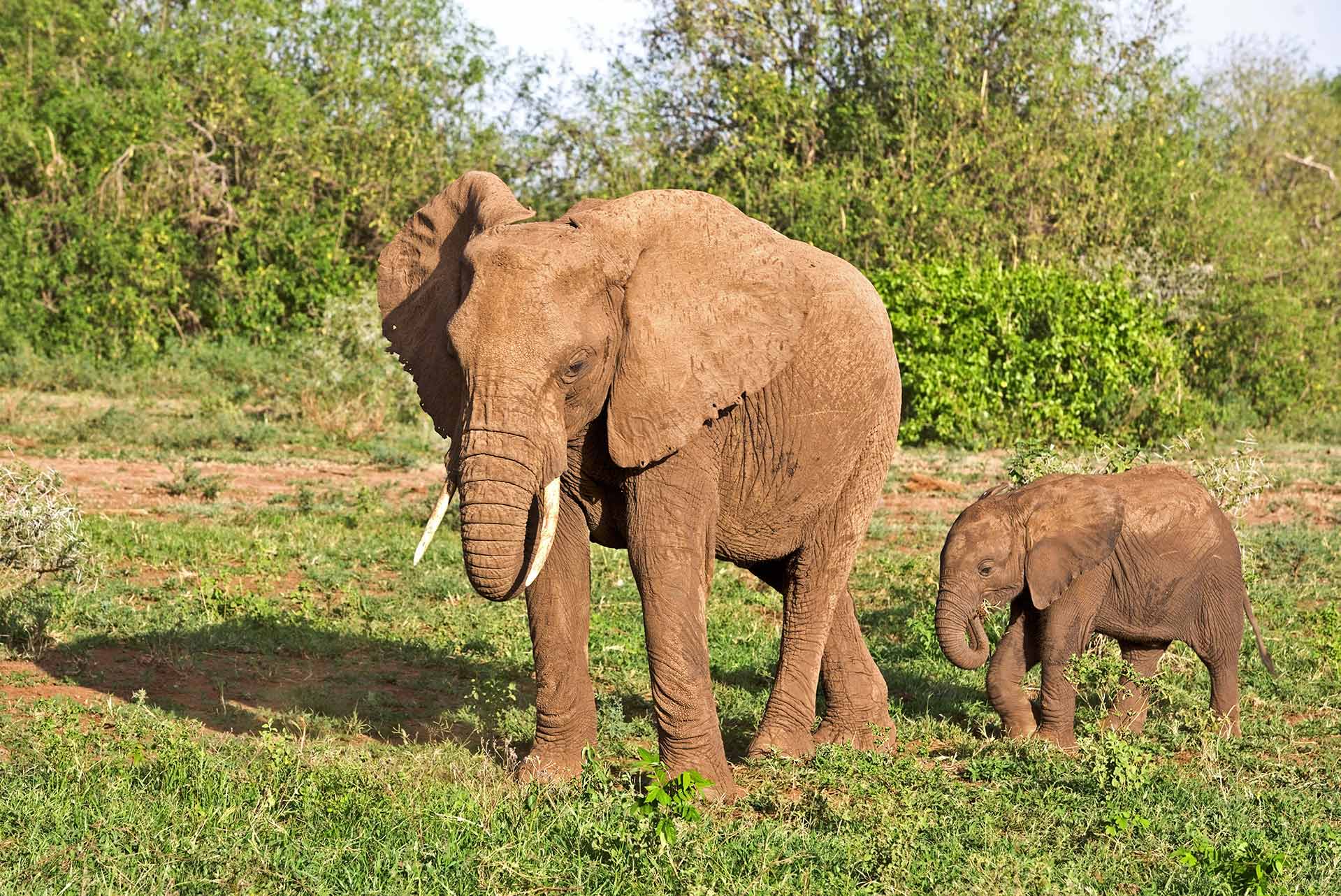
A wedge of surprisingly varied vegetation sustains a wealth of wildlife, nourished by chattering streams bubbling out of the escarpment base and waterfalls spilling over the cliff. Acacia woodland shelters the park's famous but elusive tree-climbing lions, along with squadrons of mongoose feasting on the trail of buffalo and elephant - the most pachyderms per square kilometre in Tanzania.

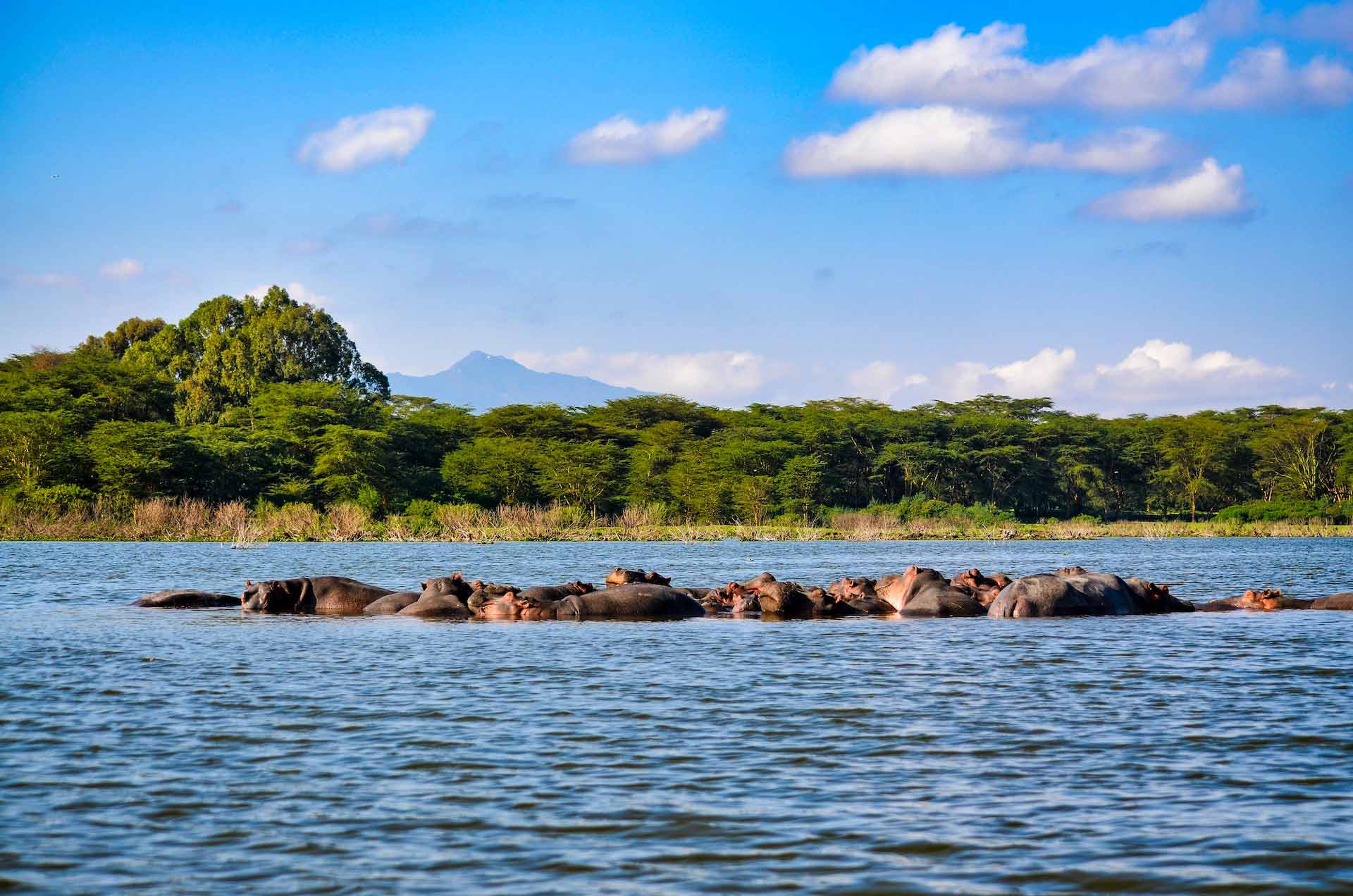
Deep in the south of the park, hot springs bubble to the surface in the shadow of the escarpment. Hippo wallow near the lake's borders of sedge. The park hosts 400 varieties of birds, including thousands of red billed quelea flitting over the water like swarms of giant insects; pelicans, cormorants and pink streaks of thousands of flamingo on their perpetual migration.

Enter Manyara from the village of Mto wa Mbu, an eclectic market town where several tribes converge to form a linguistic mix that is the richest in Africa.

Lake Manyara National Park
Size 330 sq km (about 205 sq miles}, of which about 200 sq km [about 125 sq miles] is lake.
Location In northern Tanzania, 126 km (about 80 miles] west of Arusha.
Getting there By road charter or scheduled flight from Arusha, en route to Serengeti and Ngorongoro Crater.
What to do Canoeing, with plans for forest walks on the escarpment. Cultural tours, bike tours and abseiling outside the park.
When to go Dry season (July-October] for large mammal; wet season (November-June] for bird watching, the waterfalls and canoeing.
Accommodation One luxury tented camp, public bandas and campsites inside the park; 1 luxury tented camp and 2 lodges perched on the Rift Wall; guesthouses and campsites in nearby town.

© Copyright 1999-2011 Bestway Tours & Safaris
Site last updated Sep 29, 2011
Photographs by Peter Langer & Mahmood Poonja
Website © 1999-2011 Powered by BTS